
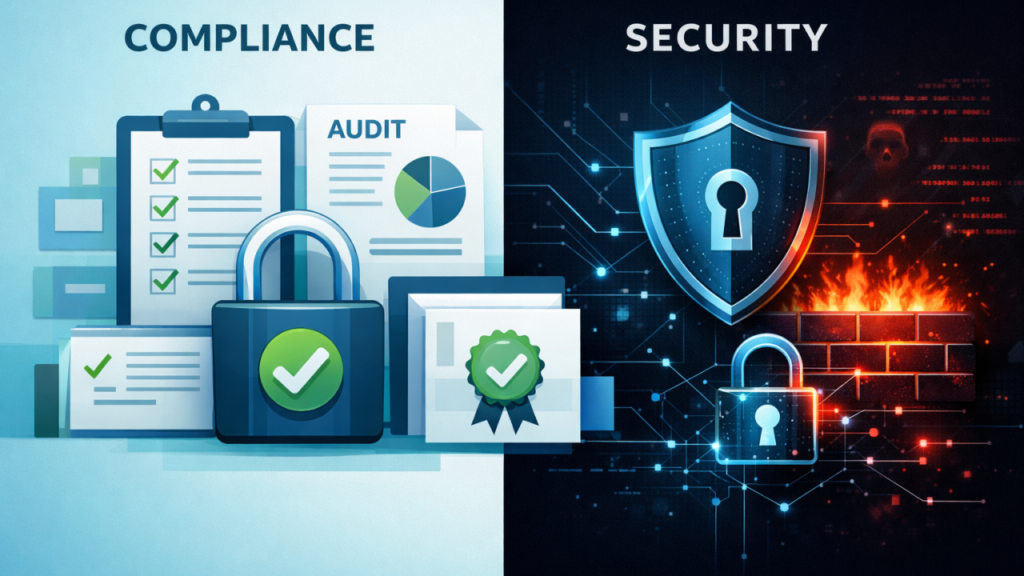
Understanding the Difference Between Compliance and Security
Compliance focuses on meeting defined regulatory, legal, contractual, or industry requirements. These frameworks establish minimum standards organizations should follow to help protect systems, customer data, and operational processes.
Security is broader, messier, and far less predictable.
Compliance asks questions like:
- Are policies documented?
- Are procedures formally defined?
- Is there evidence controls exist?
- Has required training been completed?
- Are systems reviewed periodically?
Security asks very different questions:
- Can attackers bypass these controls?
- Would employees recognize a phishing attack?
- How quickly can threats be detected?
- Can ransomware spread through the network?
- What happens if backups fail during recovery?
One focuses heavily on structure and documentation. The other focuses on real-world resilience against constantly evolving threats.
This is where organizations often get stuck. Passing audits creates confidence, but confidence and protection are not always the same thing. Sometimes they are barely even roommates.
Why Compliance Alone Creates a False Sense of Security
One of the biggest risks with compliance-driven security programs is the illusion of safety.
Businesses often treat audits like annual fire drills. Teams scramble for weeks gathering evidence, updating policies, reviewing spreadsheets, and proving controls exist before assessment deadlines arrive. Once the audit ends, security initiatives quietly drift into the background until the next review cycle appears on the calendar like an unwelcome gym membership renewal.
Attackers love this.
Cyber threats evolve continuously. New vulnerabilities emerge daily. Phishing campaigns become more convincing. Social engineering tactics improve constantly. Ransomware groups operate with alarming efficiency and surprisingly good customer service for criminals running extortion operations.
Meanwhile, many organizations continue relying heavily on controls implemented primarily to satisfy compliance requirements rather than actively reduce operational risk.
A framework can improve maturity, but security cannot depend entirely on whether boxes were checked during audit week.
 Compliance Frameworks Are Baselines, Not Guarantees
Frameworks like NIST, ISO 27001, SOC 2, HIPAA, and PCI DSS provide valuable structure. They encourage organizations to establish policies, implement controls, and create repeatable governance processes.
What they do not do is guarantee immunity from cyberattacks.
For example:
- A company may require password changes while employees still reuse passwords everywhere.
- Multi-factor authentication may exist for email accounts but not privileged administrator access.
- Vulnerability scans may occur quarterly while attackers exploit weaknesses within days.
- Security awareness training may happen annually even though phishing techniques evolve constantly.
Compliance standards are designed to create foundational security expectations, not eliminate all risk.
Businesses also face different operational realities depending on their industry, infrastructure, size, and technology stack. A healthcare provider faces different threats than a manufacturing company. A law firm handles different risks than a cloud service provider. A growing MSP likely has entirely different exposure than a retail organization with multiple locations and remote employees.
Cybersecurity cannot be fully standardized because business risk is never fully standardized.
The Problem With Checkbox Security 
Checkbox security happens when organizations prioritize satisfying requirements instead of improving actual defensive capabilities.
Instead of asking, “Does this reduce risk?” businesses begin asking, “Will this satisfy the auditor?”
That mindset creates major problems.
Controls may technically exist while functioning poorly operationally. Policies may look excellent in documentation repositories but remain ignored in practice. Incident response plans may never be tested outside conference room discussions involving coffee and optimistic assumptions.
Meanwhile, systems outside audit scope may receive very little attention despite still introducing significant risk.
This creates an environment where organizations feel secure because compliance objectives were technically achieved while real operational weaknesses continue sitting quietly in the background waiting for someone malicious to notice them first.
The issue becomes even clearer in How Audits Miss Real Security Gaps, which explores how organizations often pass formal assessments despite maintaining exploitable vulnerabilities across their environments.
 Audits Represent Snapshots, Not Ongoing Reality
A cybersecurity audit represents a moment in time.
That is it.
An organization may pass an assessment in January and suffer a major incident by March because environments change constantly.
New employees join. Vendors gain access. Applications update. Cloud services expand. Remote work increases exposure. Security configurations drift over time. Third-party integrations introduce additional risk.
Threat actors evolve quickly while many compliance cycles move relatively slowly.
This creates one of the biggest disconnects between compliance and security. Audits often evaluate whether controls existed during the assessment period. They do not guarantee those controls remain effective six months later when attackers discover new vulnerabilities or employees unknowingly expose credentials through phishing campaigns.
Security therefore cannot function as an annual event. It has to operate continuously.
That includes:
- Threat monitoring
- Vulnerability management
- Security awareness training
- Incident response testing
- Endpoint monitoring
- Backup validation
- Access management reviews
Cybersecurity is less like installing a lock and more like maintaining an entire security system while someone constantly tries finding new ways around it.
Security Requires a Risk-Based Approach
One weakness of heavily compliance-focused programs is that they sometimes encourage equal treatment across systems regardless of actual business impact.
Real security requires prioritization.
Organizations need to understand:
- Which systems are most critical
- Which data is most sensitive
- Which threats are most likely
- Which vulnerabilities create the highest operational risk
For example, privileged administrative accounts typically deserve far greater protection than lower-risk internal applications. Email security often deserves significant focus because phishing remains one of the most common attack vectors across industries.
A risk-based approach allows businesses to allocate resources strategically instead of spreading attention evenly across everything regardless of exposure level.
This is where mature organizations begin separating themselves from businesses focused purely on compliance checklists.
 Security Culture Matters More Than Most Businesses Realize
Technology alone does not create security.
Culture does.
Many organizations maintain excellent written policies while employees continue engaging in risky behaviors because cybersecurity never became part of everyday operational thinking.
A strong security culture encourages employees to:
- Report suspicious emails quickly
- Use stronger authentication methods
- Follow secure data handling practices
- Recognize social engineering attempts
- Understand their role in reducing risk
Leadership involvement matters enormously here. When executives treat cybersecurity solely as a compliance requirement, employees often adopt the same mindset.
Organizations with stronger security cultures tend to approach cybersecurity proactively rather than reactively. They improve continuously instead of only responding when audits or incidents force action.
This concept is explored further in Building a Security-First Culture Beyond Compliance, where operational habits become just as important as documented policies.
Because ultimately, the best firewall in the world still struggles against an employee determined to click every suspicious attachment they receive before lunch.
 Compliance Still Provides Significant Value
Despite its limitations, compliance remains extremely important.
Frameworks help businesses:
- Establish baseline security controls
- Improve governance and accountability
- Create repeatable operational processes
- Meet contractual obligations
- Satisfy regulatory requirements
- Improve customer trust
- Strengthen organizational maturity
For many organizations, compliance frameworks provide the structure needed to begin improving cybersecurity programs properly.
The problem appears when businesses stop there.
Compliance should support security, not replace it.
The strongest organizations use frameworks as foundations while continuously improving defenses based on evolving threats, operational realities, and business-specific risk exposure.
Continuous Improvement Is What Creates Resilience
Cybersecurity is never finished.
Threat landscapes evolve too quickly for static security programs to remain effective indefinitely. Organizations therefore need continuous improvement strategies that adapt alongside changing technology and attack methods.
That includes regularly evaluating:
- Emerging threat trends
- Control effectiveness
- Incident response readiness
- Employee awareness levels
- Third-party risk exposure
- Vulnerability remediation timelines
Penetration testing, phishing simulations, tabletop exercises, and ongoing monitoring all help organizations identify weaknesses before attackers do.
More importantly, they help businesses validate whether controls actually function under real-world conditions instead of simply existing inside documentation.
 Compliance and Security Work Best Together
The goal should never be choosing between compliance and security.
Mature organizations understand they need both.
Compliance provides structure, governance, accountability, and consistency. Security provides adaptability, operational resilience, and threat defense.
When combined effectively, frameworks like NIST, ISO 27001, and SOC 2 become valuable components within broader cybersecurity strategies rather than limitations businesses reluctantly tolerate for audit purposes.
Organizations that treat compliance as the finish line often remain vulnerable despite passing assessments.
Organizations that treat compliance as one part of a larger operational security strategy are significantly better prepared for modern cyber threats.
And in cybersecurity, preparation matters far more than how impressive your audit binder looks sitting untouched on a shelf. Want to identify security gaps before attackers do? Click the button below to book a cybersecurity assessment with our team.