

The hacker had tried everything.
He started with finesse—phishing a small business to gain email access. That breach gave him a doorway into a prestigious law firm, which nearly fell to a trojan. Then he pivoted to targeted blackmail, sending anonymous emails to wealthy individuals using stolen fragments of personal data.
But so far, none of it worked. The law firm had detected the trojan. The blackmail targets had resisted. The original business had recovered control of its inbox. And although he still had access to thousands of contacts and data from the prior hacks, his window of opportunity was closing.
Now, the hacker shifted gears.
No more subtlety. No more personalized attacks. This time, he would go loud.
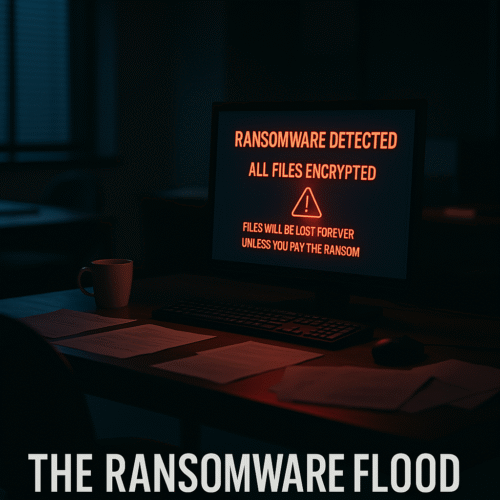
A Change of Strategy: Volume Over Precision
The attacker returned to the data he had harvested in his fits attack (read the story here). Between the original small business, the law firm’s exposed contact metadata, and the clients connected to both, he had access to hundreds—possibly thousands—of business email addresses.
These were real addresses, belonging to real professionals. Many of them had received emails from these companies before. Their spam filters would trust the source.
The hacker began preparing his final move: a ransomware campaign, aimed at everyone in the compromised databases.
This time, there would be no need for social engineering, no careful targeting, no sophisticated blackmail narratives. Just a simple, brutal message hidden inside a familiar-looking file.
The Ransomware Rollout
Each email carried a subject line that matched the original company’s tone:
- “Revised Agreement – Urgent Signature Required”
- “Updated Terms – Please Review Immediately”
- “Important Billing Update – PDF Attached”
The message was short, professional, and forgettable. The attachment looked like a PDF, but once opened, it triggered a payload—a piece of ransomware disguised as a legitimate document.
It encrypted the files on the user’s computer within minutes. Word docs, spreadsheets, project files—everything was locked, renamed, and rendered useless. Then came the message:
“Your files have been encrypted. If you want them back, send 3000 USD in Bitcoin to the wallet address below within 72 hours. If payment is not received, your files will be lost forever.”
Unlike the trojan, this attack didn’t need to stay hidden. In fact, it wanted to be noticed. Panic was part of the plan.
A Last-Ditch Effort That Still Causes Real Damage
While the ransomware was unsophisticated, it didn’t have to be advanced to cause harm. A few victims paid. Others lost access to their files permanently. Some companies had backups. Others didn’t.
The hacker finally managed to squeeze some revenue out of the week-long operation—not through clever deception or high-level manipulation, but through volume and fear.
It wasn’t elegant. It wasn’t impressive. But it worked.
This chapter proves a brutal truth: a single email breach can lead to weeks of fallout—and impact companies that had nothing to do with the original attack.
Prevention is Cheaper Than Recovery
If any part of your contact list falls to phishing, it can come back to you as ransomware. If one client gets sloppy, your inbox becomes a threat. That’s why email security is not a one-time fix. It’s a continuous, network-wide responsibility.
At Solecreation, we’re seeing more of these hybrid attacks—where one breach becomes a chain of evolving tactics. From phishing to trojans, blackmail to ransomware, the attacker will keep trying until you stop them.
We help companies:
- Segment and secure contact databases
- Detect anomalies in outgoing emails
- Set up ransomware-resistant backups and protocols
- Simulate multi-layered attacks to test your real-world resilience
- Harden systems after even minor breaches, so they don’t escalate
You may not be the first target. But you could be the next victim.
Ransomware is the final knock at the door. Make sure yours stays locked.